

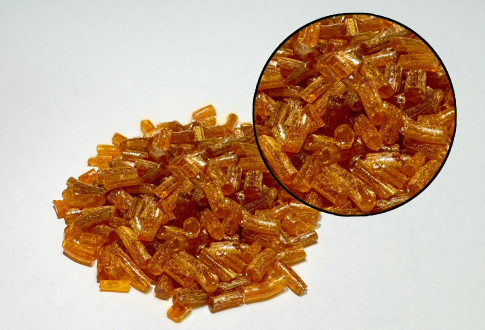
Features
•High dimensional stability | •high ductility | •corona resistance | •chemical resistance |
•Low linear expansion coefficient | •radiation resistance |
Usage
•structural component | •New energy vehicle motor cable | •Turbocharger sealing ring |
•Transmission seal | •Motor busbar insulation film | •Wear-resistant pads, wear-resistant strips, and pipe clamps |
•Wear-resistant components in centrifugal pumps |
Typical performance
Performance | Value | Unit | Method |
Color | tawny | / | / |
Density | 1.36 | g/cm3 | GB/T 1033.1-2008 |
| Tensile strength | ≥100 | MPa | GB/T 1040.1-2008 |
| Elongation at break | ≥10.0 | % | GB/T 1040.1-2008 |
| Bending strength | ≥120 | MPa | GB/T 9341-2008 |
| Flexural modulus | ≥2600 | GPa | GB/T 9341-2008 |
Notched impact strength | ≥120 | kJ/m2 | GB/T 1043.1-2008 |
| Compressive strength | ≥200 | MPa | GBT1041-2008 |
| Rockwell hardness | ≥90 | HRE | GB/T 3398.2-2008 |
| Water absorption | 0.34 | % | GB/T 1462-2005 |
| Coefficient of thermal expansion(CTE) | 50(23~350℃) | ppm/K | GBT36800.2-2018 |
| Glass transition temperature(Tg) | 260 | ℃ | ASTMD4065-12 |