
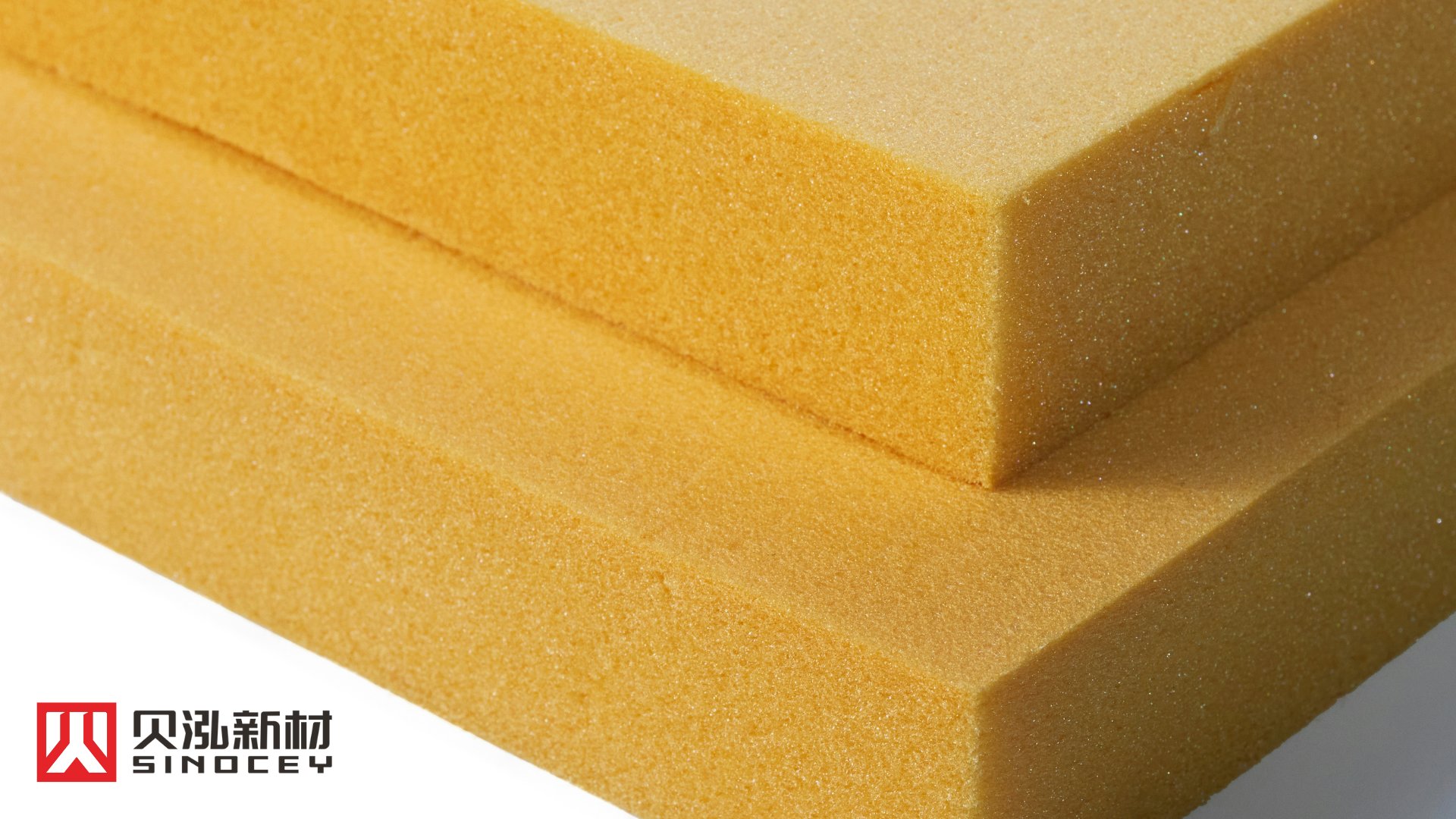
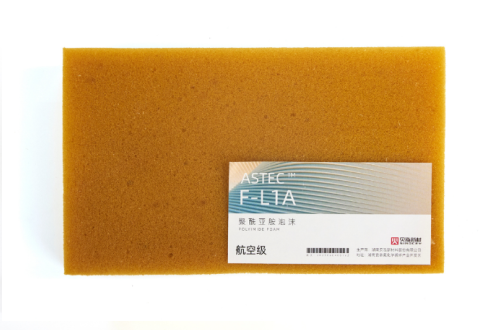
Features
1. Low thermal conductivity and temperature resistance: The thermal conductivity is less than 0.04W/m▪K, with a wide operating temperature range, high temperature resistance level, and a wide long-term use temperature range (-260℃~350℃). The short-term maximum use temperature is 400~500℃.
2. Flame retardant properties: Upon exposure to high-temperature flames, the surface charring and coking occurs without melting or dripping. It instantly extinguishes upon removal from the fire, and almost no smoke or toxic gases are emitted. The limiting oxygen index is >40%, meeting the high flame retardant material standard of UL94-V0 (American Insurance Association standard).
3. Sound absorption characteristics: The noise reduction coefficient (NRC) can reach up to 0.75. The extremely high open porosity (≥99%) allows sound waves to quickly and effectively penetrate into the deep layers of the foam and be transformed into grid vibrations, which are then consumed, effectively eliminating reflected sound waves and achieving sound absorption.
4. Chemical resistance and durability: It exhibits high chemical stability, resisting hydrocarbons, alcohols, and weak acids and alkalis. It will not decompose, shrink, or age under conditions of high temperature, high humidity, high vibration, or high wind speed. It also remains intact and does not produce debris when subjected to friction or compression.
5. Environmentally friendly and non-toxic: No halogens, heavy metals, formaldehyde, or ozone-depleting chemicals are used in the production process; no fiber dust is generated and no toxins are volatilized during installation; during use, the maximum concentration of released substances at room temperature for 90 days of sealing does not exceed the "Allowable Concentration of Air Components in Nuclear Submarine Cabins"; high-temperature pyrolysis toxicity tests verify that it is a low-toxicity material; smoke density is ≤5, smoke toxicity is low, and it poses no harm to the environment.
6. Convenient post-processing and installation characteristics: It can be easily processed into various specifications of sheets, cylinders, or irregular shapes through machining methods such as cutting, shaving, and turning. Foam installation is very convenient, requiring no special tools, and can generally be fixed on metal or non-metal surfaces using adhesives or welding studs;
7. Other characteristics: lightweight (density <10 kg/m3), low dielectric constant, low moisture absorption, radiation resistance, etc.
2. Flame retardant properties: Upon exposure to high-temperature flames, the surface charring and coking occurs without melting or dripping. It instantly extinguishes upon removal from the fire, and almost no smoke or toxic gases are emitted. The limiting oxygen index is >40%, meeting the high flame retardant material standard of UL94-V0 (American Insurance Association standard).
3. Sound absorption characteristics: The noise reduction coefficient (NRC) can reach up to 0.75. The extremely high open porosity (≥99%) allows sound waves to quickly and effectively penetrate into the deep layers of the foam and be transformed into grid vibrations, which are then consumed, effectively eliminating reflected sound waves and achieving sound absorption.
4. Chemical resistance and durability: It exhibits high chemical stability, resisting hydrocarbons, alcohols, and weak acids and alkalis. It will not decompose, shrink, or age under conditions of high temperature, high humidity, high vibration, or high wind speed. It also remains intact and does not produce debris when subjected to friction or compression.
5. Environmentally friendly and non-toxic: No halogens, heavy metals, formaldehyde, or ozone-depleting chemicals are used in the production process; no fiber dust is generated and no toxins are volatilized during installation; during use, the maximum concentration of released substances at room temperature for 90 days of sealing does not exceed the "Allowable Concentration of Air Components in Nuclear Submarine Cabins"; high-temperature pyrolysis toxicity tests verify that it is a low-toxicity material; smoke density is ≤5, smoke toxicity is low, and it poses no harm to the environment.
6. Convenient post-processing and installation characteristics: It can be easily processed into various specifications of sheets, cylinders, or irregular shapes through machining methods such as cutting, shaving, and turning. Foam installation is very convenient, requiring no special tools, and can generally be fixed on metal or non-metal surfaces using adhesives or welding studs;
7. Other characteristics: lightweight (density <10 kg/m3), low dielectric constant, low moisture absorption, radiation resistance, etc.
Usage
It is primarily used for heat insulation of aircraft fuselages, insulation of aircraft air conditioning pipelines, insulation of aircraft wires and equipment, noise reduction in wings and cabins, protection of engine casings, radar antennas, and structural components of aircraft.
Typical performance
Performance | Unit | Value | Method |
Bulk density | kg/m³ | ≤10 | GB/T 6343 |
Tensile strength | KPa | 150~200 | GB/T 6344 |
| Moisture absorption rate by mass | % | ≤5 | GB/T 20312 |
| Compression set | % | ≤15 | GB/T 6669-2008 方法A |
Thermal conductivity(24℃) | W/(m·k) | ≤0.04 | GB/T 10294-2008 |
Flame spread index(FSI) | <5 | ASTM E84 | |
| Smoky development index(SDI) | <10 | ASTM E84 | |
| Limiting Oxygen Index | % | >40 | GB/T 2406.2-2009 |
| Noise Reduction Coefficient | 0.7 | ASTM C423 and E795,Mounting A | |
| Sustainable maximum operating temperature | ℃ | 350 | |
Maximum allowable temperature for short-term use | ℃ | 400 | |
| 5%Thermogravimetric temperature | ℃ | >500 | |
| Acid resistance (soaked in 20% hydrochloric acid for one week) | No significant change | ||
| Oil resistance (soaked in 93# gasoline for one week) | No significant change | ||
| Radiation-resistant | After the cumulative radiation dose reaches 10,000 Gy, there is no significant change in appearance | JJF 1018 |